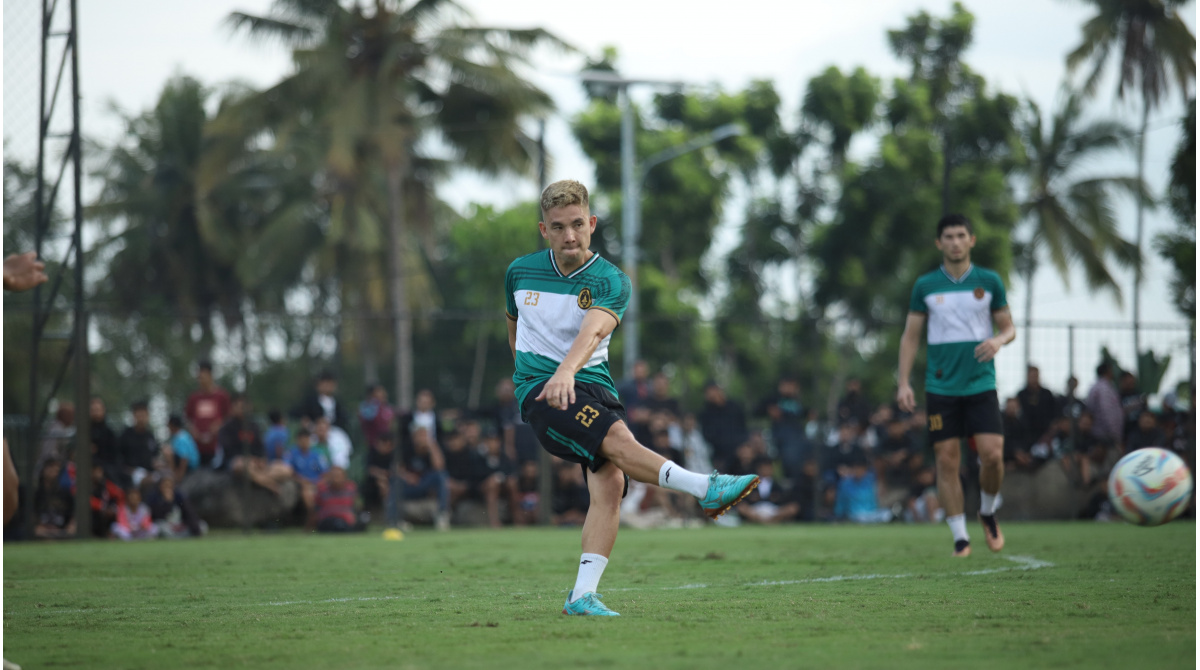
Graduated from professional football

©PSS Sleman/Septiano Dio
In his youth he played at Karlsruher SC alongside Matthias Zimmermann, Lukas Rupp and Simon Zoller. As a professional, Kim Kurniawan found happiness in Indonesia. The 34-year-old is now one of the most famous footballers in his father’s country of birth. At Transfermarkt, the midfielder with 1.2 million Instagram followers talks about his unusual path after he had actually already finished playing professional football.
No matter which Indonesian city, as soon as Kim Kurniawan strolls through the streets, it usually doesn’t take long before he is approached by the first fans. In the Southeast Asian country he is considered a football idol and a star. “I don’t like the word star,” emphasizes the PSS Sleman midfielder. “I’m still Kim from little Knittlingen in Baden-Württemberg.”
He has now gotten used to being spoken to by strangers – especially since the Indonesians are very polite. The hype initially came as a surprise to Kurniawan. He says: “I didn’t see it coming and so I just feel grateful. I look forward to every autograph request and every photo. It’s funny when you think back to the time when I was still a nobody and could stroll through Indonesia with virtually no problems.”
Bad luck with injuries at KSC: Kurniawan “was done with professional football”
In Karlsruhe, Kurniawan went through the youth ranks from the F-youth level. He rose to the U19 level, but was unable to fulfill his dream of playing professionally. “I still remember my then U17 coach saying to me: ‘Kim, if you were ten centimeters taller now, you would already be training with the professionals.’ I was always the smallest, but I made up for it all with hard work, hard work and discipline.” Kurniawan made it to the U19 Bundesliga.
Instead of playing professionally, Kurniawan from the Karlsruhe A-youth suffered a torn meniscus that took him out of the game for six months. A turning point, because professional football was suddenly very far away. Kurniawan changed his mind, moved to the association league club FC Heidelsheim and began studying business administration at Pforzheim University. It was more of a coincidence that in 2010 he received the request from Indonesia, his father’s country of birth, from the then first division club Persema Malang with the German coach Timo Scheunemann.
“I had long since finished playing professional football at that point and had come to terms with the fact that it wasn’t meant to be.” But Scheunemann was looking for German players with Indonesian roots. “I was immediately enthusiastic about the idea,” remembers Kurniawan. “I really wanted to do it, but my parents were anything but enthusiastic. I should concentrate more on my studies. In the end they supported me and let me do it.”
Kurniawan’s reception in Indonesia: “I was speechless”
When Kurniawan thinks back to his arrival in Indonesia, he has to smile. “At the time I had no idea how important football was in the country. When I arrived at the airport, I thought to myself that a supervisor would pick me up. But not only was there a supervisor waiting for me, but also thousands of fans. I was really speechless. I also thought they were confusing me with another player, but they all wanted my autographs.”
Even after arriving, Kurniawan couldn’t help but be amazed. “In Indonesia, most players stay together in a hotel and then travel together in the team bus to the training ground,” he reports. “When the bus broke down, we had to take rickshaws to the training ground. Suddenly we were recognized by fans on the street and caused an additional traffic jam because everyone wanted to take photos with us.”
But the early days were anything but successful in terms of sport. Kurniawan again had to deal with bad luck with injuries. A few days before his first league game he broke his ankle. “That was a hard time. My parents didn’t want me to go back to Indonesia and to resume my studies. But I got so many get well messages from the fans that it gave me something to work towards.”
Indonesia: No training at prayer times and evening games at 40 degrees
After his return to the pitch, he was also introduced to the country’s typical rituals in training and training design. “The training conditions here are very professional and of a very high standard. The training design of course depends on which coach is in the club. European coaches have a different playing style than Asian coaches. In Indonesia, prayer is highly valued due to the Muslim faith. Accordingly, the training times are adapted to the prayer times. We usually train early in the morning and then again in the evening. What I still haven’t gotten used to is the heat. There are regions in Indonesia where we play even in the evening at temperatures of 40 degrees. That’s tough.”
In Indonesia, badminton and football are in a neck-and-neck race for status as the number one popular sport. While badminton is popular due to its numerous Olympic successes, football surpasses everything when it comes to viewership. “We have a really big fan culture. It is not uncommon for stadiums to be filled with thousands of fans. The fans are very passionate and creative. Unusual choreos are just as much a part of everyday life as pyrotechnics. You can just tell that football is popular among the entire population. What I find interesting is the unwritten rule that you can only be a fan of the club in your area. So a fan from Karlsruhe should only be a KSC fan and not a Bayern Munich supporter.”

International match in Jakarta: Fans of the Indonesian national team in the World Cup qualifiers against Japan
What makes Kurniawan sad are the outbreaks of violence, “especially when there are derbies. During my time at Persib Bandung, we had to be taken to the Persija Jakarta stadium in armored cars. Very often there are mass fights between the fan camps, which I don’t understand at all. Football should bring love and joy and not hate and violence.”
Kurniawan’s bad luck with injuries remains – mostly shortly before his international debut
When the 34-year-old looks at his career so far, he feels great gratitude. He played for a total of four Indonesian clubs and played almost 180 league games. But you also notice melancholy in the stories of the southern Germans – these serious injuries again and again. He was completely out of action for the 2016/17 season due to a broken fibula, a back injury followed in 2019, later a shoulder injury, and he is currently out again with a torn meniscus.
“The injuries actually always came at inopportune times, usually just before I was due to play for the national team. Every footballer knows that it’s not the injury itself that’s the worst thing, but rather the time in rehab and the brooding. Above all, you have to be mentally strong during this time in order to come back even stronger on the pitch.”

Kim Kurniawan in Indonesia ©PSS Sleman/Septiano Dio
Kurniawan can now look back on 14 years in Indonesia and explain what sets football apart in the country: It is less tactical. “The clubs play with an open mind, there is no scanning. Indonesian football is characterized by speed because many actions are decided on the wings. In my opinion, there are a lot of talents who could make the leap to Europe,” says the veteran.
Indonesia’s national team on the rise? “Change has occurred”
But it’s not just the Indonesian league that is improving in quality, the national team is too. Quite a few experts believe that Indonesia could play a good role in Asian football in the future and one day qualify for a World Cup.
“There has been a change since Erick Thohir, the former owner of Inter Milan, became president and Shin Tae-yong became national coach,” says Kurniawan. “The national team has currently found the right mix. On the one hand, the naturalization of players like Jay Idzes or Thom Haye, and on the other hand, the consistent use of young talents like Marselino Ferdinan or Rizky Ridho. Both have the potential to become big Indonesian football stars and idols in the future.”
For Kurniawan, however, there are plans for the future away from the pitch. He has already started studying sports management. “I feel absolutely at home in Indonesia, but you never know where football will take you at some point. Of course it would be a dream to be able to work in Germany at some point.” There are also a lot of things back home that Kurniawan misses – for example, in the winter “the snow and the snowy Christmas markets. That’s why we usually fly to Germany as a family over Christmas so that our children can bake cookies with grandma and grandpa and listen to Christmas carols. But that won’t work this year because it’s Boxing Day here.”
Interview: Henrik Stadnischenko
