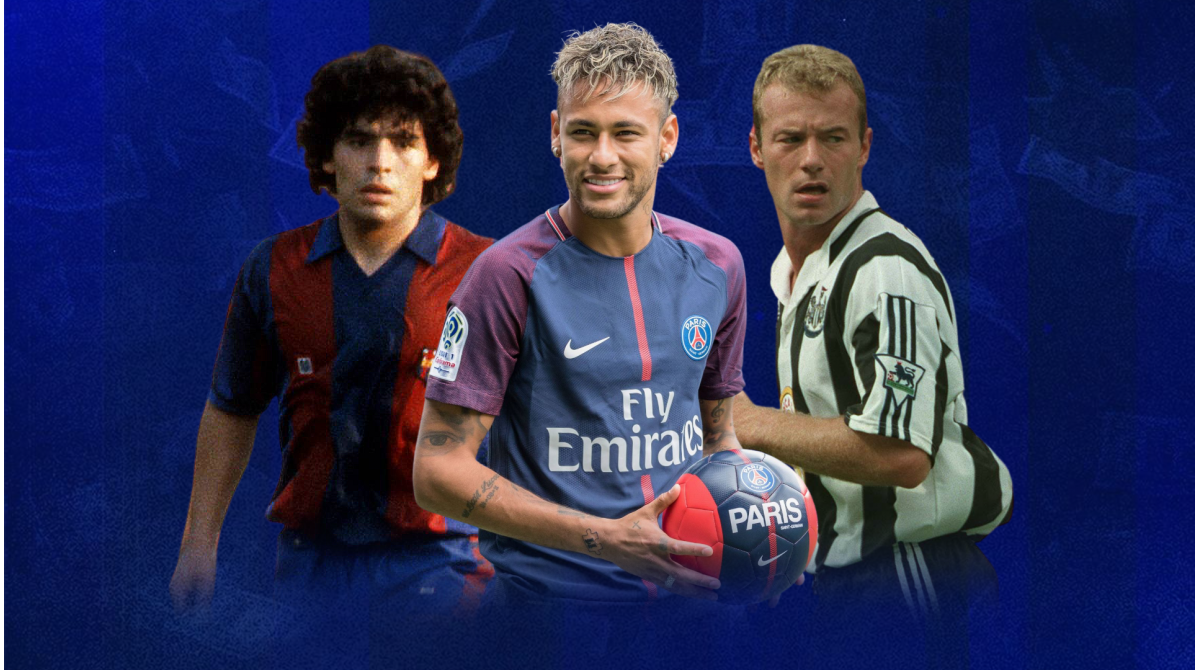
Broken 18 times since 1982

©TM/IMAGO
In July 1982, a transfer shocked the football world: FC Barcelona brought 21-year-old Diego Maradona to the Camp Nou for what was then the highest transfer fee ever paid. The Catalans transferred the equivalent of 7.3 million euros to Argentinos Juniors to secure the services of the “golden boy” (El Pibe de Oro). Fans and journalists alike were stunned by the total, which was double the previous record – a record set by Maradona himself within Argentina.
42 years later, even mid-table clubs in the Bundesliga can pay such sums; the record has since been exceeded 17 times. Most recently by Neymar in 2017 during his transfer from Barça to Paris Saint-Germain. Transfermarkt looks at the players who have since become the most expensive in history.
Some of the once most expensive footballers in history have gone down in the annals as superstars – others, however, were unable to fully meet the high expectations of their new clubs. Maradona in Barcelona can also be classified in this category – despite his impressive scoring values - due to his short stay. His time in Spain ended in 1984 after a brawl in the Copa del Rey final against Athletic Bilbao in which the Argentine was at the center. Yet he won three trophies with Barcelona and was even applauded by Real Madrid fans when he scored a brilliant solo goal in the Clásico. However, Maradona only achieved world fame at his next stop, SSC Napoli.
From 1986 to 2001, the transfer record changed almost every year
The next person to break Maradona’s record was the Italian Roberto Donadoni. In 1986 he moved from Atalanta BC to AC Milan for the equivalent of 8 million euros. Maradona held the top position in transfer fees – in two stages – for five years, but from Donadoni’s transfer onwards the record was broken almost every year until the turn of the millennium. The era of big transfers began in 1990 at the latest with Roberto Baggio’s move from Fiorentina to Juventus for the equivalent of 12.9 million euros. Between 1986 and 2000, Italian clubs signed the most expensive player in the world seven times.
A year after Donadoni, the Belgian Enzo Scifo took the throne. He moved from Anderlecht to Inter Milan for 8.65 million euros. Lajos Détári was an exception in 1988. The Hungarian playmaker left Bundesliga club Eintracht Frankfurt for Olympiakos for the equivalent of 8.7 million euros – to date the only time that a German club has been involved in a world record transfer. Baggio’s record, set in 1990, stood for two years before Gianluca Vialli, his fellow striker from Squadra Azzurra, replaced him. He went from Sampdoria to Juventus for the equivalent of 16.5 million euros.
Vialli’s record stood out in this era of football, lasting four years. He was replaced by another world-class goalscorer: after the European Championships in 1996, Alan Shearer, a two-time Premier League top scorer, went from Blackburn Rovers to Newcastle United for the equivalent of 18 million euros, where he was to become a legend. To date, Shearer is only one of two players among the world record transfers who went to an English club. But just a year later he was replaced by the first Brazilian record holder, Sonny Anderson, whom Barcelona signed from Monaco for 26.25 million euros to replace a compatriot: just three weeks later, the great Ronaldo moved for 26.5 million. Euro from the Catalans to Inter Milan amidst great media hype.
After Ronaldo, the record was broken five times within four years: in 1998, Real Betis paid around 30 million euros to FC São Paulo for super dribbler Denilson. Compared to expectations, like Anderson in Barcelona, he was perhaps one of the unfulfilled promises – even if the winger was a regular in Seville for years. The Italian Christian Vieri had a much greater influence at Inter, who signed him from Lazio in 1999 for around 46.48 million euros. As reigning champions, the Biancocelesti broke the 50 million mark for the first time just a year later and brought in Hernán Crespo from AC Parma for 56.81 million euros.
Real Madrid’s Galacticos and Neymar: The transfer records since 2000
The fact that this transfer was the most expensive in football history for only around two weeks was due to the fact that Real Madrid ushered in the Galacticos’ first era with the signing of Luís Figo in mid-July 2000. The Portuguese cost 60 million euros and the fact that he came from Barcelona, of all places, caused one of the biggest transfer controversies in history – including a pig’s head being thrown at him from the stands at Camp Nou.
From 2001 onwards, an eight-year era in terms of transfer records was characterized by the then best midfielder in the world and the second Galactico at the Royals: Zinédine Zidane came from Juventus for 77.5 million euros. Adjusted for inflation, his transfer is still considered the most expensive in history. In the 2000/01 season, Real Madrid achieved sales of around 138 million euros, and in 2023/24 the Champions League record winner became the first football club to break the billion mark in annual earnings.
The Galactic’s dominance continued in 2009 when Real signed Cristiano Ronaldo from Manchester United for €94 million. Four years later, the club even broke the 100 million mark (101 million euros) for the first time for Tottenham star Gareth Bale. The Welshman was the most expensive footballer in the world for three years before United lured Paul Pogba from Turin back to Old Trafford for 105 million euros. Neymar set the record that still stands today with his 222 million euro transfer a year later. Whether this will ever be cracked is, if not impossible, at least questionable. When it comes to market values, Vinicius Junior and Erling Haaland are the first two players since Kylian Mbappé in 2018 to have achieved a market value of 200 million euros. Barcelona’s Lamine Yamal is also well on his way there. If Neymar’s transfer fee is not exceeded in the next two years, the Brazilian would overtake Zidane as the longest reigning record holder.
