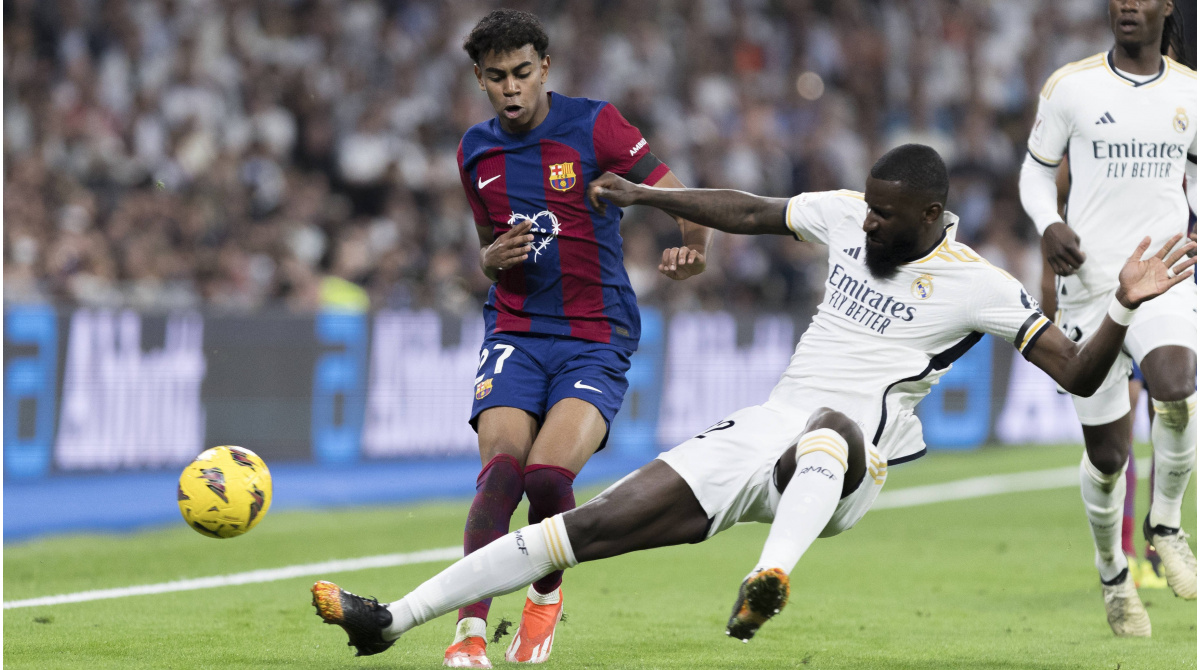
World stars vs. homegrown

©IMAGO
Few games in world football cause as much excitement as El Clásico. This Saturday it’s that time again: Real Madrid welcomes FC Barcelona to the Santiago Bernabéu, bringing together, among other things, 20 premier class triumphs and 63 championship titles. In the last 20 seasons, only twice has another club, Atlético Madrid, won Campeón in LaLiga. This season both clubs are at the top of the table, with Barça currently three points ahead of the Whites. After the exhilarating Champions League nights with Barcelona’s 4:1 against FC Bayern and Real’s 5:2 against Borussia Dortmund, a spectacle is expected in many places.
El Clásico has taken place 257 times so far, with the Madrilenians winning 106 times, the Catalans winning 100 times and a draw 51 times. While there has been continuity in the coaching chair with Carlo Ancelotti at Real since 2021, there has recently been greater fluctuation at Barça. Hansi Flick has been in office since this summer and immediately began turning the club around, but also adapted his predecessor Xavi’s approach of relying on the top talents from the famous La Masia Academy. Real is pursuing a different idea: Ancelotti’s team is peppered with international stars like Kylian Mbappé or Jude Bellingham or early-scouted top talents at the time like Vinicius Junior and Federico Valverde. Transfermarkt presents the two philosophies in more detail.

Different approaches: Real Madrid’s superstars against FC Barcelona’s La Masia
As the graphic shows, Real and Barcelona’s squads are put together quite oppositely at the moment. At Real Madrid there are currently only three homegrown players in the team with the seriously injured Dani Carvajal (32), Lucas Vázquez (33) and Fran García (25), while the Blaugrana have twelve. Nevertheless, it can be said that Los Blancos have modified their strategy of spending big on the most sought-after stars, which produced the Galacticos in the 2000s, in recent years. Vinicius Junior and Rodrygo, for example, were signed by their Brazilian youth clubs when they were 17 and 18 respectively and then completed their training. At the same time, exceptional talents such as Mbappé, David Alaba and Antonio Rüdiger continued to arrive – but for free. Without paying exorbitant transfer fees compared to other clubs, Madrid’s team is full of international superstars and has the world’s most valuable squad at 1.36 billion euros.

It is also noteworthy that of the 15 most valuable Real players, none come from the club’s home country (5 Spaniards, 17 Legionnaires). In stark contrast to this is FC Barcelona, which is increasingly relying on its own talents after the recurring financial difficulties and currently has 18 Spaniards in the team with only eight foreign professionals. Twelve academy graduates have already played for the first team in LaLiga this season.
FC Barcelona and La Masia: Rediscovering your own identity
This development goes back many years. In 1998, during his first term as Barça coach, Louis van Gaal announced: “I dream of a team that wins the European Cup and consists entirely of players from our youth team.” The Dutchman was therefore instrumental in turning La Masia into the club to make it what it is today and helped make its debut to a number of talents who later became global stars: Xavi, Andrés Iniesta and Carles Puyol. During one of the most successful periods in the club’s history, when they won four Champions League titles between 2006 and 2015, the backbone of the team consisted of players from Lionel Messi’s academy.

However, after the record sale of Neymar for 222 million euros to PSG in 2017, the club changed its approach, which almost ruined Barcelona. The club spent a total of €390m on Philippe Coutinho (135m), Ousmane Dembélé (135m) and Antoine Griezmann (120m) to fill the gap left by Neymar, but the trio were able to make their big transfers never justify. After further expensive signings and recurring problems in meeting the salary cap, it now looks as if Barcelona are returning to their strengths. The Catalans are increasingly relying on their own talent pool, a process that Xavi initiated out of necessity during his time as coach. This can be seen from the expenditure in the last two years.
The current offspring seems to be another golden generation of La Masia. Led by the outstanding 17-year-old Lamine Yamal, who already has a market value of €150 million – the highest in Transfermarkt history for an U18 player. But central defender Pau Cubarsí (MW: 40 million) also stands out, who is also only 17 but is much further ahead than others his age. The 21-year-old defensive midfielder Marc Casadó (15 million) has a good overview of the game and showed an excellent performance against Bayern’s experienced midfield. Fermín Lopez (50 million) is another 21-year-old who regularly finds himself in the starting XI and excelled at the Olympic Games in the summer before suffering a serious injury. Pedri (80 million), who does not come from La Masia, and Gavi (90 million), who only recently returned from a long-term injury, have developed into stars in recent years.
Indeed, at the moment, Flick could be making van Gaal’s dream come true and fielding a team made up entirely of academy graduates. This eleven would not be FC Barcelona’s strongest, as Robert Lewandowski and Raphinha, who are currently in top form, are not there, but it would still be one that would be quite competitive and, with a total value of 498 million euros, more valuable than the entire BVB squad (475.30 million).

