
Dressed in bright pink and black pants and socks, the referee of the match signals the start of the match with a long whistle. It is nine in the morning in the Malilla neighborhood. The largest soccer school in the city of Valencia. It’s not a normal Saturday. It’s return Saturday. After many days waiting for the damn DANA and its terrible consequences, Valencian football is beating again. Not the first division, which will do so next week and Valencia will have to make up their postponed League and Copa del Rey matches quickly, but grassroots football, amateur football, the other. Thousands of games in a weekend in which the smiles and the sweaty shirts, the socks, the boots, the shin guards, the ritual return. Blessed normality. From juniors to veterans. From people who play for fun to natural competitors. From Serranos to Mestalla. The ball is rolling and that is great news.
“Football is part of their lives, if you take it away from them they are missing something,” Gabi, general director of Malilla, tells me while taking a sip from a cardboard cup. A club is more than just a team. It backbones the neighborhood, backbones the city, backbones the province. In football everyone knows each other. The WhatsApp groups between sports directors and presidents have been fuming these days. DANA has brought solidarity in abundance. Many teams have offered their fields, their equipment and their hands. “Here we set up a team of people and we all got on to help here and there. We were overwhelmed with help from the neighborhood: we are next to the affected area and no one hesitated.”
Bocata, songs and 2,844 games
The ball is still in play and it smells like steak and ‘blanc i negre’ (the most Valencian sandwich in history with black pudding, sausage and garlic oil). On the field two kids of about eleven years old fight for a ball on the sideline and in the small stands the father who knows more about football than Simeone does not fail, the mother who cheers with songs from the nineties, an older man from the neighborhood who already has his little kids’ game on Saturday when he goes down to buy bread, and the hype man who forces you to go to the field well armed with a good portion of ibuprofen to make it to the afternoon.
Gabi is a lifelong football guy, he knows what he’s talking about. The type of people who should be included in the meetings of the reconstruction plan that Salva Gomar, president of the Valencian company, has announced. With the cut halfway a “referee the hour” thunders, blessed normality. In two days they have played 2,844 games of the 3,300 scheduled, corresponding to all categories. A pleasure.
Football is part of their lives, if you take it away they are missing something
Gabi (General Director of Malilla)
The matches take place throughout the province. But in all of them there is a strange feeling. a minute of silencethe Senyera on the grass and black armbands on all teams. Some tears remembering what happened, especially in the veterans’ games.
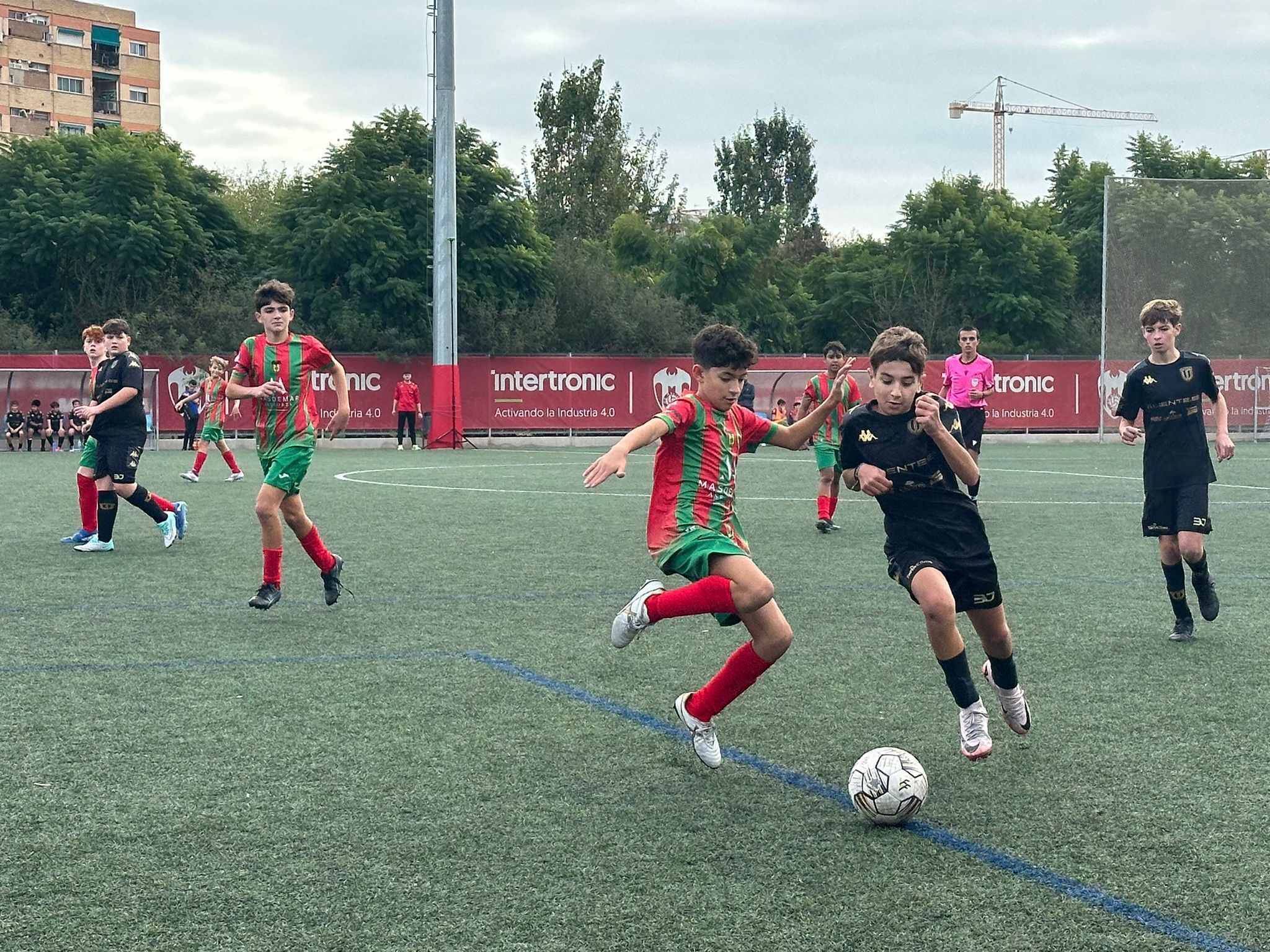
Two kids fight for a ball in one of the weekend gamesDIEGO PICÓ
The ground zero match
There is one marked on the agenda. The Quart de Poblet against the Benetusser. It is the only game of the day in which a team from the affected towns, from ground zero, will play. They are older, but the drama has hit hard, very hard. The match ends in defeat for the visitors, but playing in these conditions is already winning. I approach the field almost incognito. I don’t want to ask, just observe. There is an obvious sense of respect and almost pity. Many of the Benetusser players have lost everything, but none of them have deaths in their backpack.
There is a hall of honor, a minute of silence and the occasional hug, half furtive, which makes it clear that DANA has left a trace of solidarity between peoples that should not be lost. They are a little tense and don’t feel like remembering the tragedy, I suspected. They want to play, to forget, even if it’s just for a while. Change the grass for mud, harmful mud.
There are no taxis anymore
A few hours before, at the Benimodo sports center, the Carlet children are playing. There are a dozen teams of this town that are also suffering their share with the flood. The city council has given them the facilities and the boys have regained their enthusiasm. “It is difficult to get around because many parents, almost all of them, have lost their cars and in these categories there is no other way to go to the fields than by pulling the parents’ ‘taxi’,” a man who looks like a manager tells me. There are parties and that is saying a lot. And whoever can’t play, invents it.
All the parents of the players have lost their car and many, their house
Javi (E1 Paiporta)
The UD Aldaia (razed town) organized a day of coexistence on Saturday and training at the Martínez Torres school and the Technical Center. Other clubs such as Loriguilla, Alaquàs and Barrio del Cristo offered them facilities. There is hope.
A scrap metal field
The province and the tens of thousands of players are recovering their heartbeat. But others still have to wait. I speak with Javi, the alma mater of E1 Paiporta. They have lost everything and obviously, they still cannot even consider playing again. Javi tells me that they are calling the parents of the more than 500 players at the club one by one. “At the moment everyone has lost their car and many of them have lost their houses,” he tells me with a lump in his throat that is dissolving over time. Paiporta has taken the fatal blow, the epicenter of DANA. The field has disappeared, right now it is a scrap metal cemetery, it will take months to recover it, but now we have to think about the kids. “We have looked for teams in which to continue training, they have to play and have a good time and if they cannot do so here, they have to continue,” He comments knowing that this could cause him some problems in the future. “It’s hard because I’m sure some will decide to leave because we don’t have the facilities in place, but we’re going to move forward and we’re going to get up.”
The fight is finding places in which to train and play. It’s more complicated than it seems. The affected areas are many, fields and material have been lost at the point of a shovel and not all of them fit.
The reconstruction
On Sunday the day continues and the games and the hype guy who doesn’t go home. In many conversations the “it’s about time” echoes and in many others the ‘reconstruction plan’ is repeated with intensity. The RFEF together with the Valencian team face one of the greatest challenges in their history. Dozens of fields must be built, Help dozens of teams and recover thousands of games that have gone to limbo. Money, effort and success.
In many groups they talk about how they are going to orchestrate it. Gomar, the president, has walked these fields thousands of times. He’s a guy who really likes football. and no one has to explain to you how or where more help is needed. But everyone fears bureaucracy and administration. “This is not going to happen from one day to the next,” Javi tells me, knowing that his club is going to have a hard time this season. Help is going to arrive, it must arrive, but without fields it is difficult for football to recover normality in the most affected areas. Almost impossible.
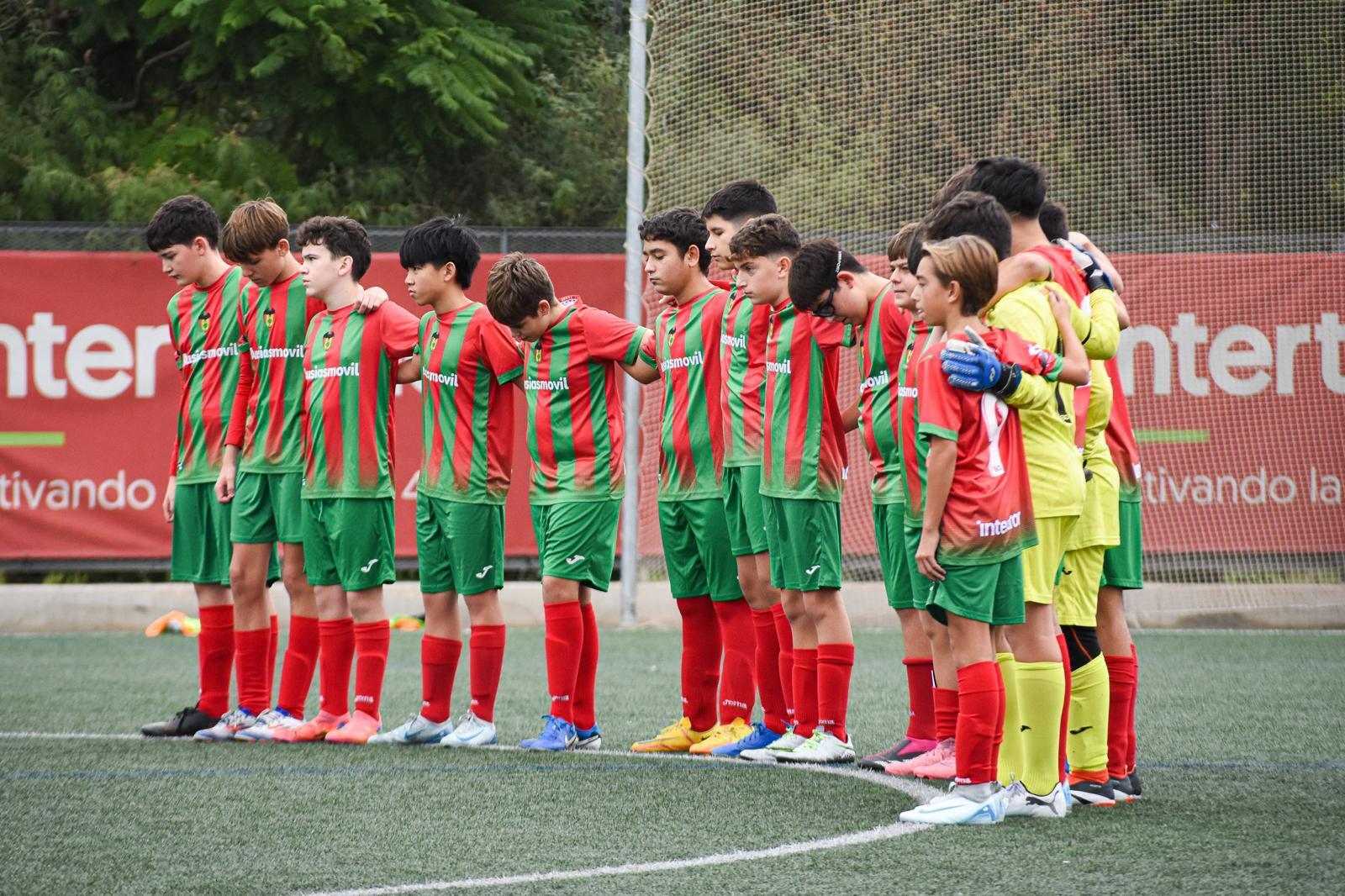
Malilla’s minute of silenceDIEGO PICÓ
From the Valencian Federation they state that there are 39 facilities affectedwith 18 football fields devastated, but also with several facilities in the reconstruction phase.
Sunday is ending and there are still some games going on. Dim light in some fields fight to reach the end of a day in which little attention has been paid to the scoreboard. Winning was playing again and that idea has been repeated over and over again by the coaches of the hundreds of teams that have returned to activity.
I return to Gabi, to Malilla, a neighborhood school that is much more than that. A club manager invites us to the vino, in a paper cup, it still smells like a Valencian lunch sandwich and no one spares an applause for a play by a kid who plays it like a movie. Again sport, again football pulling everything and everyone.
