
Real Madrid fell tonight in 22 offsides.
-Only?
That was the response to the Press from the Welsh coach John Benjamin Toshack on November 1, 1989 after his team succumbed again to Milan in a European Cup tie. Real Madrid had won 1-0, insufficient after the 2-0 in the first leg at San Siro. Once again the white team had fallen into Arrigo Sacchi’s favorite ambush, offside, the trendy tactic imposed by Hansi Flick’s Barça in this campaign.
Sacchi, despite his expertise, was not an inventor. There is no football notary where it is recorded who was the first coach who made offside a way of life. However, something was brewing in the 60s in Central Europe.
The ‘Sinibaldi effect’
The rearview mirror leads to Anderlecht and a Corsican coach, Pierre Sinibaldi, who would later coach Las Palmas and Sporting de Gijón. In sixties football, Belgium did not make much noise until a European Cup tie between Di Stéfano’s Real Madrid against Anderlecht arrived in 1962. A win was presumed. In the first leg at the Bernabéu, the surprise result was 3-3. In Brussels, in the second leg, 1-0. Anderlecht had slammed the door with Sinibaldi defending a revolution of high pressure and offside.
Sacchi’s Milan revolutionized football.
And the offside of the 20th century is not the offside of today. Without VAR, throwing offside was Russian roulette in which the lineman’s flag and the atmosphere in the stands spurred sentences. That did not stop a handful of daredevils from dreaming of leaving their rival without an answer.
Arrigo Sacchi is a football genius, he marked an era, he took care of all the details, he even told us how to place our foot. Barça’s line is almost perfect, it’s nice to see them
Santi Denia (Former player and current under 21 coach)
After Sinibaldi, two Belgian coaches appear on the radar, Raymond Goethals and Guy Thys, that will promote the same philosophy. The first begins to thunder from a modest one, the St. Truiden. The second was done on the Beveren bench. From Belgium, an influential trident is thus formed that launches a seed that sprouts in Holland.
Rinus Michels’ total football
In the Dutch territory the so-called total football. It is the homeland of the exchange of positions and the advancement of defense. The book is started by Rinus Michels, architect of the first glorious Ajax until 1971, when he landed at Barça, a position he combined with the Dutch team. In the ’74 World Cup, Holland showed on television how to execute offside.
Those long-haired men of genius and talent commanded by Johan Cruyff They amaze the world because when they lose the ball they go in droves to attack the rival who again and again succumbs to the offside net.
Played in the ’74 World Cup against Uruguay, Argentina or Brazil They become manuals that have not aged. There are actions in which six or seven players fall into an illegal position before the orange skill. Michels simplified that: “What we do is defend forward.”
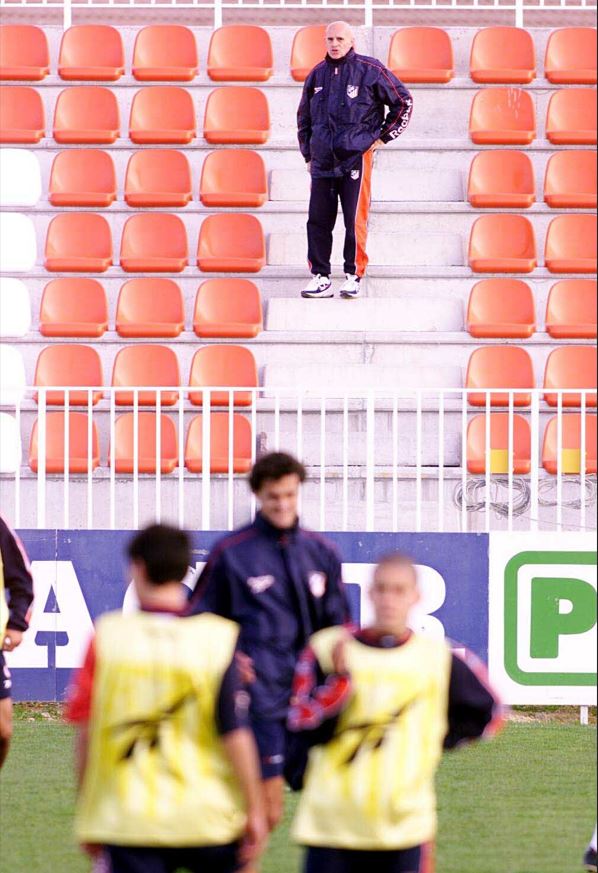
Arrigo Sacchi observes a training session during his time at Atlético de Madrid.BRAND FILE
The objective of all the fans of that tactical arrangement was to leave the rival without time to think, what in Argentina was articulated as shrinking spaces with another inspiration, César Luis Menotti, a coach destined to leave a legacy.
The revolution of Arrigo Sacchi
Every theory harbors someone who takes it to the extreme. In that warehouse we must place Arrigo Sacchi, a coach without a football pedigree who arrived at Milan in 1987 to revolutionize the way of watching football. Playing against that squad was tactical torture. To the cry of ‘Milan’, voiced by Franco Baresi, The team moved forward to neutralize the rival’s attack. Tassotti, Costacurta and Maldini operated alongside him, a quartet that was recited on the fly.
Van Basten, one of the legionnaires who never understood the boss of that suicidal plan, he records in his memoirs that in the hotels some colleagues heard cries of “offside, offside” from Sacchi’s room at dawn.
The Dutch team surprised with the offside in the 1974 World Cup.
Real Madrid suffered that tactical explosion in two consecutive seasons in the European Cup, 88-89 and 89-90, in this one with Toshack, the day Real Madrid fell into 22 offsides, the first of them after 30 seconds. Only in the first half did he stumble into the ambush at minutes one, three, four, eight, twenty-one, twenty-six, thirty-nine, forty-one, forty-four and forty-five.
Butragueño summed up the feeling of those clashes: “They seemed like 20, and we seemed like ten.” Gullit recently expressed in MARCA that Milan “made the field very small.”
Meanwhile, the antidotes and consequences spread throughout the universe of the ball. In Colombia the figure of Pacho Maturana emerged, another bailing doctor who with the Nacional de Medellín made a name for himself on the technical catwalk. The Colombian team pushed Milan to the maximum in the 1989 Intercontinental final, in which they only lost 1-0. Maturana summed up that team’s score like this: “We defend to make defense the art of attacking.”
Goethals’ antidote and the attack on the flag
That Milan won the European Cups in 1989 and 1990. In the 1991 edition, when they seemed like an armored team, they were paired in the quarterfinals against the thriving Olympique de Marseille… by Raymond Goethals, that Belgian druid. The duel was a slate from start to finish with two teams committed to offside. 1-1 in Milan and 1-0 in Marseille.
The match crushed fair play. In the 87th minute the Velodrome stadium suffered a blackout. Milan chose not to return to the field of play seeking the French disqualification. The trick went wrong and UEFA sanctioned Milan with a year without playing in Europe. Goethals was the locksmith of the Sacchi era, who moved to the Italian team.
Years later, in 1998, Sacchi extended his theory about Atlético de Madrid. The Italian only lasted in office until February, enough time so that his methods were not forgotten. One of his most repeated exercises was the so-called ‘Attack on the flag’. It consisted of placing the eleven players in a half of the field where flags of different colors had been placed.
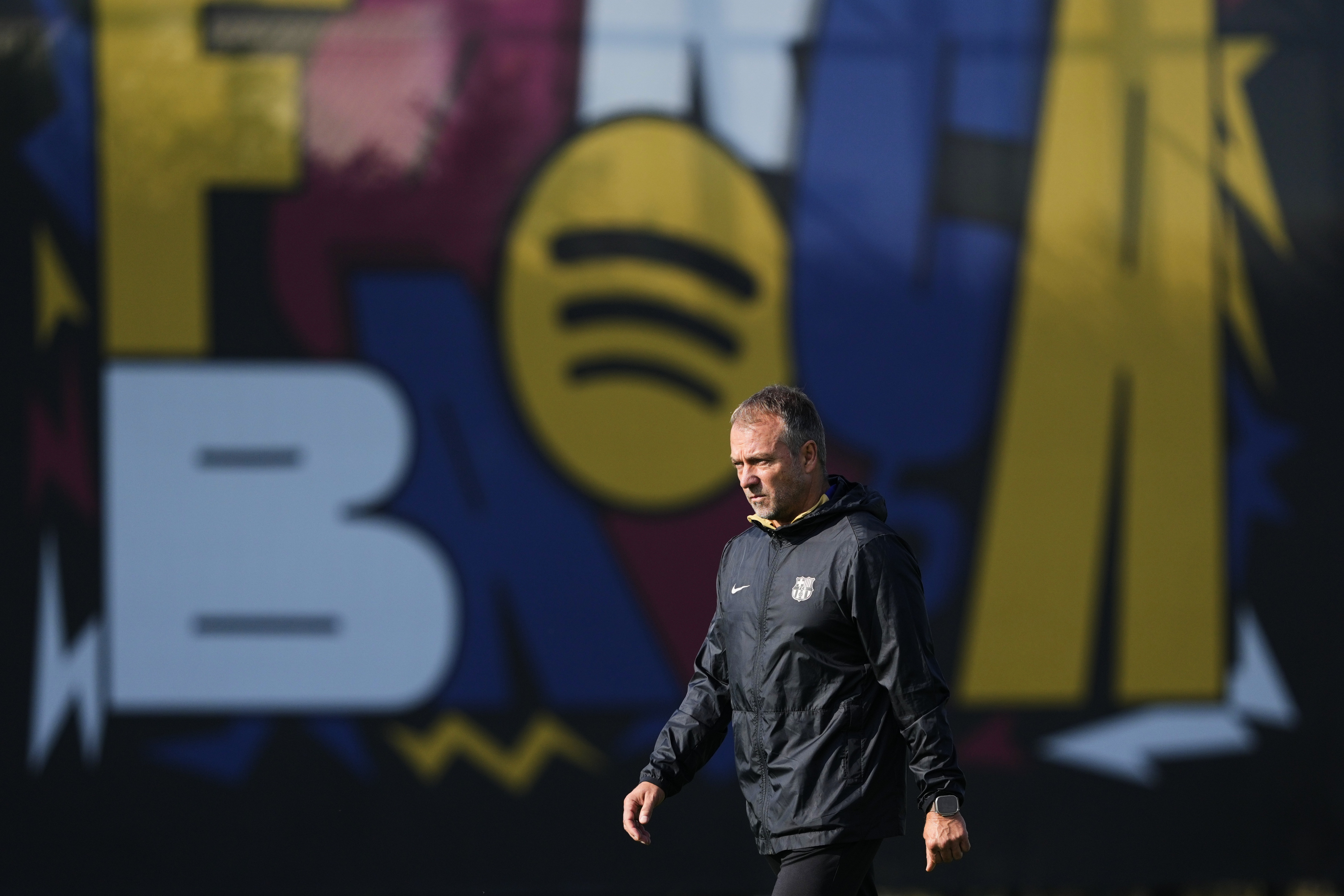
Hansi Flick, in a recent training session with Barcelona.EFE
Offsides caused this season
Barça leads the 5 major leagues in the number of times it causes rivals to fall in an illegal position. Teams like Real Madrid and Atlético have only achieved 16 offsides from opposing teams.
A leader with no rivals nearby.
- Barcelona – 86
- Parma – 43
- Osasuna – 39
- Brighton – 37
- Ol. Marseille – 36
- Milan – 35
- Stuttgart – 35
- Fulham – 34
- Chelsea – 33
- Auxerre – 32
- The Palms – 32
The technician shouted ‘yellow’, ‘red’, ‘blue’ etc. and the block tilted to suffocate to that flag that occupied a space in an area of the field. Sacchi watched the exercise and corrected the players’ positions. When training with the ball and the team did not steal it, the line of four defenders did the accordion, going up and down the line.
Foot position work
Santi Denia, current under-21 and Olympic coach of Spain, He was part of that red-and-white squad as a center back with Sacchi, whom he considers “a football genius, like Cruyff or Guardiola. He went to detail. He marked an era and I learned a lot from him. “He told us how to turn and when to reduce spaces.”
Regarding this working method, Santi Denia highlights how “Sacchi liked the team to be together.”prioritized defensive work. He even told us how to place the feet. All of this requires a lot of training. Also with Antic we went with the forward line. With Solozábal he understood me with a glance and we also knew that Molina was behind us, if we advanced the line he also came out a lot.”
Santi Denia, who operated as a center back in a defense with Chamot, Aguilera, Njegus, Torrisi, Serena and Toni Muñoz, among others, remembers that those in that position “are the ones who should be most concentrated. If there is a mistake there is a clear opportunity against. The key is to reduce space. Knowing what to do, knowing how to move when there is a backward pass from the rival or if an opponent has made a bad control”.
Barça surprises with how well it does; The best was Sacchi’s Milan, they did not do it in all the plays but when Baresi decided and that makes an opponent very uncomfortable, they do not know how to face the play
Pichi Alonso (Former player and coach; Movistar analyst)
The coach believes that offside “is complicated both when executing it and when avoiding falling into it. At Barça you can see that they believe in that and see that it works. This is achieved with hours of training. The line is almost perfect. They shape up well. It’s nice to see them. And when they have suffered a problem they continue to believe in it. “The important thing is to work on it and to be believed, to have no doubts.”
Kiko, Atlético’s forward at that time under Sacchi, admitted having learned “more with Sacchi in five months than in my seven years previous professional ones.” The striker revealed that he had held conversations with the Italian almost at dawn.
Van Basten has called several times for the abolition
Dutch legend defends offside recall
- After being one of Sacchi’s soldiers at Milan who extremeized the use of offside, Marco Van Basten He has sponsored the current that calls for its abolition in football. The Dutchman has defended his theory from different positions. From 2016 to 2018, FIFA appointed him Director of Technical Development. Inside and outside that task, Van Basten He explained why he requested the elimination of offside:
“I still have my doubts about offside, because I am convinced that it is not a good rule. I would at least like to do a test to show that football is also possible without offside. I’m sure it would be better without him. If we didn’t have offside, we would have a lot less problems and the teams would have other solutions to offer a good game. “Teams would find a way to play without offside.”
Pichi Alonso, former player and coach, and now a Movistar commentator, He admits that Flick’s Barça offside “has surprised him because of how well they are doing. It is not easy to coordinate the start, to ensure that no one is left behind, that the full-backs are organized, but To advance the line, the fundamental thing is that there is pressure on the rival passer. The difference between this Barça and other years is that everyone runs and presses.”
Some remedies to avoid ambush
Alonso reviews ways to study this strategy to overcome it: “The rivals are thinking and studying how to avoid it. For example, for the forwards You do not have to make vertical unmarkings, but rather run your defensive line horizontally and then break. That, the one who did it in an extraordinary way was Hugo Sanchez. And also, let those on the second line come in.”
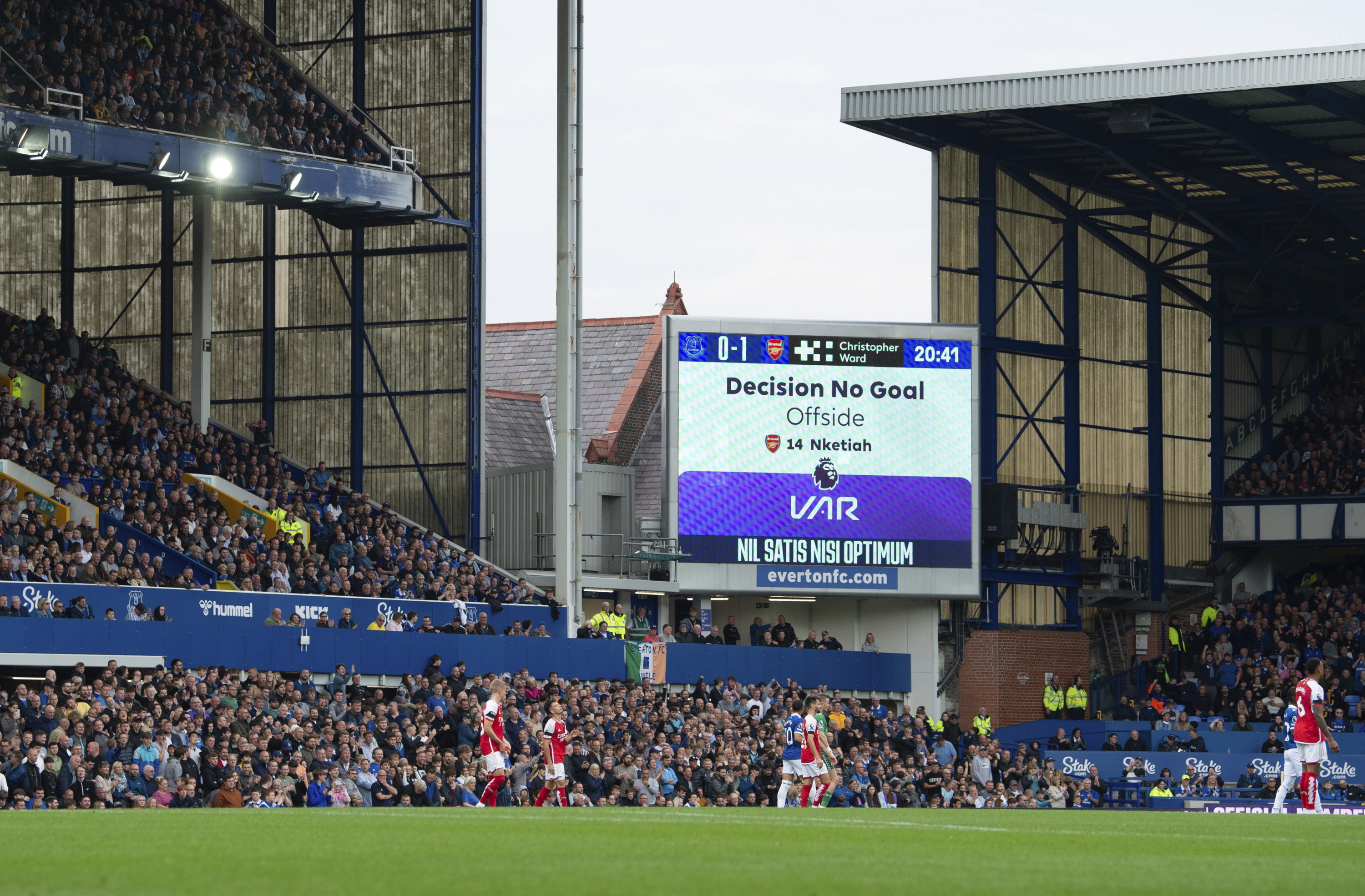
Score in a Premier League match with the result of an offside review.EFE
In his career, Pichi Alonso was coached by technicians from that school: “Menotti called him the shrinking of spaces. “I remember the opening match of the ’82 World Cup at the Camp Nou between Argentina and Belgium and what the Belgians did, with Guy Thys, was even more shameless than what Barça does now.”
For a footballer facing a team dedicated to offside is a kind of adventure. Pichi Alonso reveals that “the day I felt most uncomfortable as a player was in the UEFA final of Espanyol against Leverkusen. In the first leg in Sarriá they did not play from behind as we had seen in other games. They threw us offside. If you don’t expect it, you are more aware of your opponent’s movements than your own. “We hadn’t even talked about it and we changed on the fly.”
Baresi and the importance of a leader
Pichi is clear that the team that has done the best “is without a doubt Sacchi’s Milan. In addition, he had Baresi as a leader. Milan did not do it in all the plays, He did it when Baresi decided. That for a rival player is very uncomfortable.. You don’t know how to face the play. What I do? Do I distance myself, don’t I distance myself?”
The offside chase follows the conductors into the room. In 1997 the tribute to Franco Baresi was celebrated with a match at San Siro between Milan and an international team that ended 5-1 for the locals. In an appointment for entertainment, Sacchi’s Milan libero took care of ordering the offside as if it were an official appointment to the surprise and amazement of the witnesses.
What Barça does speaks very well of its coach; Without fast centre-backs you cannot set the line in the midfield and with lazy players in the pressure after loss, neither can you.
Javi Gracia (Former player and current coach)
Javi Gracia, former player and current coach, believes that applying offside “It depends on the team you have and its characteristics. All coaches will say that we want to be a dominant, brave, offensive team, all that, but the objective is to get the team to perform. If you have centre-backs who are not too fast you cannot put the line in the midfield. Or if you have players who are lazy in the pressure after a loss, neither.”
Timing with the pin
Barcelona’s strategy enters into the analysis and Javi Gracia believes that there “you see a lot of work behind it. Most fans were looking forward to the games against Bayern and Madrid, who had very fast players, and look, they did just as well. That speaks very well of his coach. Even players who have no experience in First Division do it well. To achieve this coordination on the line there is no other secret than work.”
For Javi Gracia, the antidote to that strategy “in theory is not that difficult. We all see the game and how the rival has fallen. But then, in the reality of the game, you have to achieve synchronization between the passer and the gap breaker, or change the orientation of the game, or look for a diagonal. And if you look for the back of the defense there is the goalkeeper, who is also forward.”
In the references in this tactic, Gracia also points towards “Sacchi’s Milan. It is the first team that I remember that did it so much and with that daring. Barça now takes it to a very brave level. “Sometimes you don’t know if the risk is running forward or on the contrary, having to run backwards.”
