Fernando Belasteguín (Pehuajó, 1979) is facing the last days of his professional career. Behind him are 30 years of success with the racket in his hand, countless titles and a legacy that goes beyond padel itself. Now, and before starting the Comunidad de Madrid P1 of Premier Padel, he opens up to MARCA with his most personal side.
Question: How are you facing the week in Madrid?
AnswerI’m really looking forward to it. I have a special affection for this city, I grew up there, I lived there for seven years until I got married… so I’m very happy, I’m looking forward to playing now. In 2008 I went to Barcelona, a city where luckily I’ve done well, so I’m very happy.
Q. What do you think if I tell you out loud that you have three months left in your career?
RI think I have to take advantage of it. It’s been 30 spectacular years, but I don’t want to rush into things and I’m focusing on Madrid. Many friends tell me that I have to enjoy these last few months… and I enjoy being competitive and giving it my all. This last year has been a bit strange because I’ve had injuries, I’ve been out of some tournaments, I’ve played well, I’ve played badly… but I want to end up doing well, especially in several consecutive tournaments.
I went from feeling indestructible to being a sand castle
Fernando Belasteguin
Q. How does it feel to have that farewell atmosphere around you all the time?
RWell, what shocks me the most is when I leave tournaments because I’ve lost and I think ‘wow, this is the last time I’ve played here’. I thank Premier Padel for wanting to have a detail with me in cities that have been special to me, like this one.
Q. In 2020, in an interview with MARCA, you said that when you retire, the first thing you would do would be to apologize to your family. Does that mean that padel has taken more from you than it has given you?
RIt would be ungrateful to say it so categorically, but I am clear that it has taken away a lot of time from my family, who are everything to me. Now I think that everything I have experienced has been worth it, but maybe when my heart rate slows down and I stop, I will think something else. The only thing I am clear about is that without my wife, who took the family on her shoulders, all of this would not have been possible.
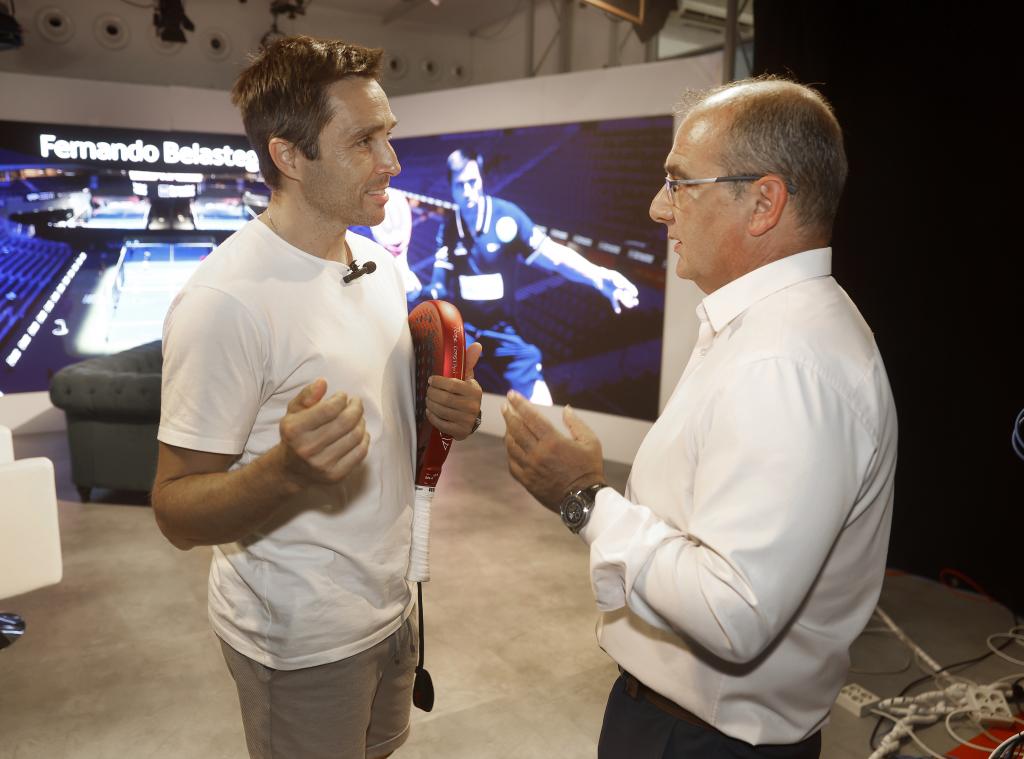
Fernando Belasteguín talks with Juan Ignacio Gallardo, director of MARCA.JOSE A. GARCIA
Q. You have always given the impression of being almost indestructible throughout your career, but what fears does Bela have today?
R. Maybe I have transmitted that, and at times I even felt that way, because I didn’t get injured and I was always competitive practically until I was 42 or 43 years old. In recent years, something else has been noticed, I didn’t feel completely well and I have been a bit more fragile because I have pushed myself to be at the level of the youngsters and nature does not forgive you. Injuries are a huge blow on a mental level, I felt fragile, and that was transferred to my game. Maybe being away from my family for so long, exposed in this world of padel, has made me a bit colder because I tried to be more immune to everything. Now I am like a sand castle, and if my family is not well, I get scared.
I am grateful that my children have seen me lose more than I win.
Fernando Belasteguin
Q. Would you change anything you have done in your career?
RI think that over time there are always many things that I might have changed. Looking back on it with the experience I have now, seeing the number of times you may have made a mistake or been deceived, but at the time… I am a person who has made all the decisions thinking that at the time it was the best thing to do and I have let myself be carried away by my sensations and my feelings. Today, with experience, I could tell you that I would have changed things, I don’t know, but what I am clear about is that in my life I have learned as much from mistakes as from successes.
Q. I remember you said in an interview that you didn’t like your children to be raised in a champion’s environment and that’s why you didn’t keep any trophies at home. How do you convey to young people, in a society where everything is immediacy nowadays, that there are important things beyond winning?
R. Look, in my case I have been lucky with that even with my children. I had a period when I won everything and they even changed the rules – putting the matches to five sets – when I played with Juan Martín, then came the stage with Pablo Lima in which they changed the balls so that everything was a bit more equal… At that time my children were small and luckily they have started to become aware of everything in these last few years, when I have lost the most in my career. So I take it as something good, I prefer that they have seen me lose much more than win. They see me train after having left a tournament early as if nothing had happened, that is why I say that sport has even allowed me to educate my children in many aspects.
Q. In recent years you have even shared the court with players who are twice your age. Does the mentality of today’s youngsters attract your attention? We see projects that don’t last long, immediacy takes priority, winning as quickly as possible…
R. When I played with the boys I never tried to teach them anything as if I were their father or something like that. I just wanted to play with them to try to win some more tournaments, aware of the difficulty that this entailed, especially at my age. I am very grateful for that. I continued doing what I always did, getting up early, training, taking care of myself, resting… and I think they saw it and were even surprised, like Arturo, who couldn’t even believe how square I am. As for the young people and their mentality, everything has changed: padel, journalism, business… sport is not alien to all this. We need padel to be very different from what it is today in the next five years, that means that the sport grows.
The rush in current padel projects is linked to the fact that the player has more people around him; if they tell you all the time that you are a phenomenon or that you have lost because of your partner…
Fernando Belasteguin
Then there is the issue of projects, immediacy… I think that all this comes because the player has more and more people around him, who feed off of him and live off of him. And if the player does not have enough ability or coldness to channel the input that comes to him, and I am not talking about social networks, then it is more complicated. If those around you tell you all the time that you are a phenomenon or that you have lost because of the person next to you, that perhaps makes your tolerance with your teammate less and less and you end up facing him. For me that is the biggest mistake, because I personally have always tried to get the best out of my teammate. Ultimately, it is the time that we live in, and you have to adapt because, if not, the sport ends up putting you in its place. And if you have to change teammates every three tournaments, then you change.
Q. Do you then see the direction this could take as dangerous?
R. Look, we’re talking a lot about changes in partners, about short-term projects… but if you look closely, throughout history, there’s a pattern. How many couples are there that can be number 1 now? There are two, like in my time with Juan Martín, for example. There were never three or four that were close. So, what I’m getting at is that sport grows, evolves, improves… but there are things that don’t change. That’s why now we have to adapt to what there is, I even think that the public likes there to be changes, I’m telling you this for real. Each player is special, each couple transmits something to you and the public grabs onto that. I really think that this helps the sport grow.
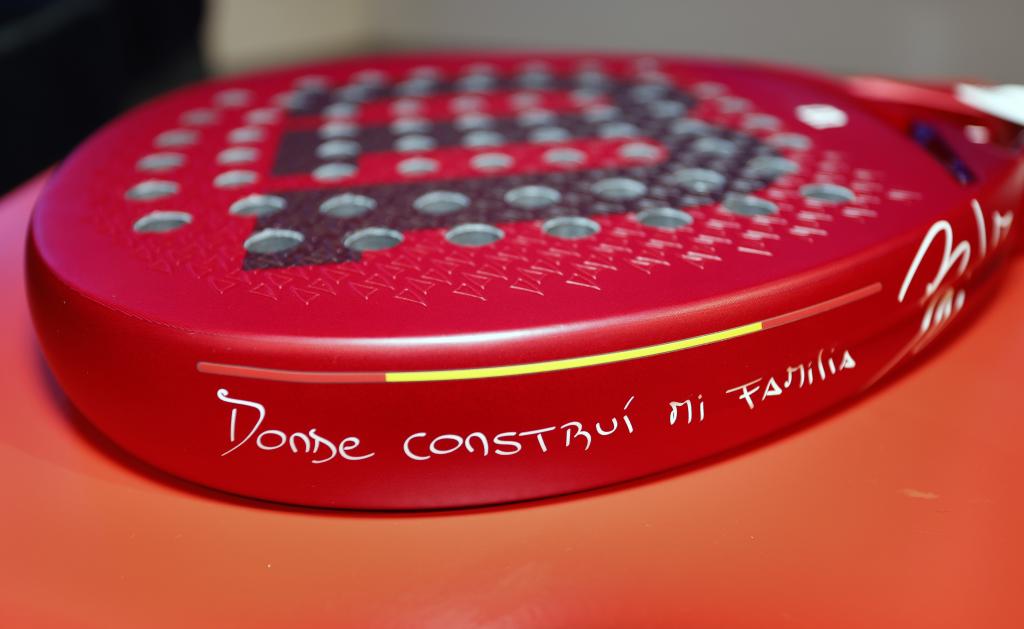
Special edition of Belasteguín’s racket for his last tournament in Madrid.JOSE A. GARCIA
Q. If you had been told, not 20 years ago, but 10, that padel would be where it is now, travelling around the Middle East, reaching countries where until recently there was not a single court… What would you have thought?
R. I wouldn’t have thought it would have happened so quickly at all. I’ve always been a person who sat in front of the circuit because I always defended that the player was the most important thing, and that led me to clash sometimes with previous organisations. Now Premier Padel is doing a great job of international expansion, and although we still go to places where there is a lack of padel culture, going every year encourages the sport to grow and develop in those places. There are many people who are investing to do this in many venues, and I have no doubt that in five years, not before, those places will end up filling the stands.
I have been demanding with myself all my life and I am and will continue to be so with those who manage padel now and in the future.
Fernando Belasteguin
Q. Is it a big shock to go almost anywhere in the world and have a line of people waiting to take photos with you? Your career began 30 years ago, selling rackets in the stands to be able to afford to go to tournaments…
RI am grateful, I am privileged. Players are becoming more professional, they can help their families a lot and that is the best thing. There is a large amount of income and I, who have been lucky enough to see the growth of this little by little, am very happy that the boys and girls can dedicate themselves exclusively to this. They are now 100% professionals, and although there is still a lot of work to be done, I am proud to see the health that padel enjoys. Of course, I have been very demanding of myself all my life and I will continue to be so with those who manage padel now and in the future.
What has brought me to be here at 45 years old is solidity, just like Lebron and Galán, being number 1 for three years; it’s not all about hitting the ball hard.
Fernando Belasteguin
Q. Before the end of your career… World Cup. Do you see yourself making the list?
R. Reca was very clear with me and told me that I was in the group of those who had to earn my place, and that’s where I am. And if I don’t get to win, I’ll be left with the great memory of lifting the trophy in Dubai at 43 years old.
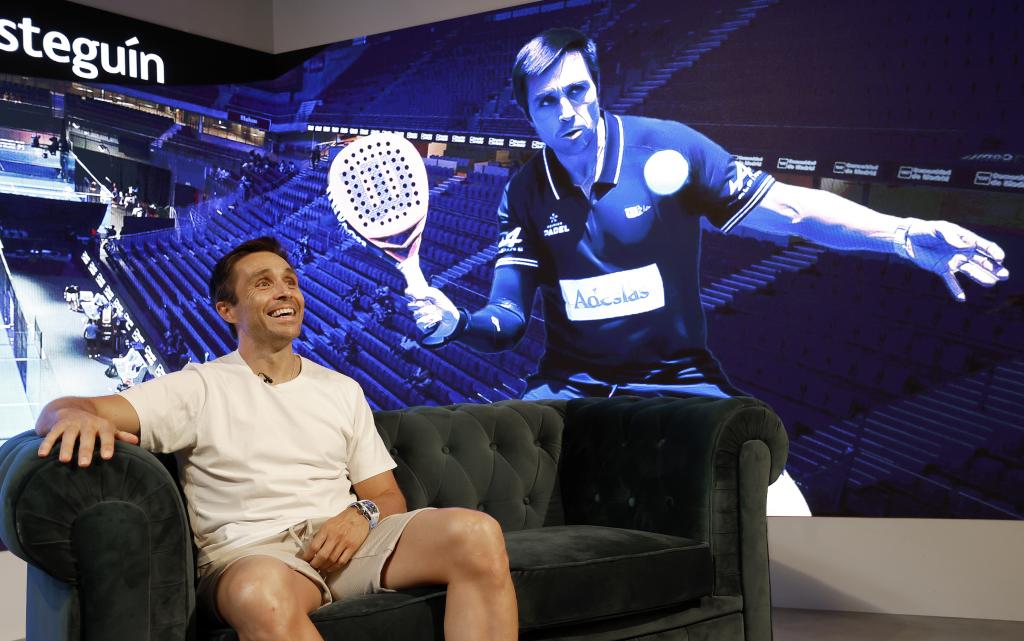
Fernando Belasteguín, during the interview with MARCA.JOSE A. GARCIA
Q. Back to the current situation. How did you get to Madrid? Did you rest during the summer?
R. I haven’t rested much, to be honest, I’ve always taken advantage of August to do a mini preseason to get to the final stages of the year in good shape. In fact, it’s something that happened to me with Arturo, with whom I won three tournaments in the final stages of 2022. I usually show my best version from September to December, and in these last three months of my career, with even more reason, I want to end up playing at a level where I feel truly competitive.
Q. What are Bela and Tello up to now? A few months ago you told us that ‘your round’ was the quarter-finals and from then on…
RWe had a very good South American tour, but we also had some defeats in the round of 16, going down at the start… I think we need to maintain a certain consistency now, and if possible reach the good peaks that we have shown in some tournaments to leave us with a good taste in our mouths. At times we have given the impression of being a very solid pairing and, at other times, that we could lose to anyone. Mind you, you can lose to anyone, let’s get this straight, but what I want to say is that the fact that the pairing is at the top is good, and to stay there it is very important to maintain the high peaks of play that we have already shown we have.
With Tello, we sometimes gave the impression of being very solid and other times, that we could lose to anyone.
Fernando Belasteguin
Q. How are you physically? Over the last two years you have been plagued by various ailments and injuries.
RThe truth is that when I wanted to press on the part Physically, something has always happened to me. My elbow, my calf… so I want to play, play well. Physically, I feel comfortable and, as I was saying before, I felt indestructible precisely because I was physically very good, which is what has traditionally filled me with confidence in my game.
Q. How would you explain to someone who doesn’t follow padel that a person of your age is competing against kids who are twice your age?
R. The key is to adapt and reinvent yourself. Now the speed of the game is different and, in my case, nature makes me slower and slower. There is a difference on the court that is quickly seen, of course, and instead of hitting the ball super hard I have to send it close and well over the net, for example. You have to keep adapting, and that is a challenge that I have always loved. Being number 1 I thought I had things to improve, imagine if I don’t think so now… Sport gets you out very quickly, that’s how it is, and that’s why I hold on tooth and nail to continue being competitive so that padel doesn’t kick me out, but rather by giving me a hand and letting me play until my last day.
Q. Is padel moving towards being a power-only sport?
R. Whoever plays padel, plays padel. Now it seems that only hitting is worth it, and even small children want to start by just hitting the ball hard before learning the most basic strokes. Look, what has led me to be here at 45 years old is solidity, just like Lebron and Galan consolidated themselves as number 1 for three years, for example. Someone has made us believe that padel is only about hitting and it is not like that.
Q. How important is Premier Padel for the growth of this sport?
RI think that today padel is learning to walk, we can run 100 meters in 10 seconds… but we need more time. With Premier it will reach a tremendous level, I have always said that padel is the sport of the future, I see it in 10 years as something very, very powerful in many corners of the planet.
I would see it as a great goal for the squad if padel became an Olympic sport in 2036, but first there is a lot of work to be done.
Fernando Belasteguin
Q. And Olympic?
R. Looking back, if we have padel in 2036, I would give it as a great goal, honestly. But before that, we have to work a lot, although 12 years go by very, very quickly.
Q. What will Belasteguín be like after the player?
R. I will continue to be involved in padel, for sure, and also in training. I am not afraid of getting bored, I have many concerns, several business projects, also the expansion of the Bela Padel Center, which is something that motivates me a lot… and in sport I will be there to help in whatever way I can so that it continues to develop. If I have time left, I will be there for it, no doubt about it.
Q. Will there be a Bela Jr in the future playing professional padel?
R. My son Fede has already switched to padel, but for now they are giving him Wilson rackets because he is my son. We will see if they give them to him because he plays well (laughter). The important thing is that they play sports, have fun and give it their all.
